
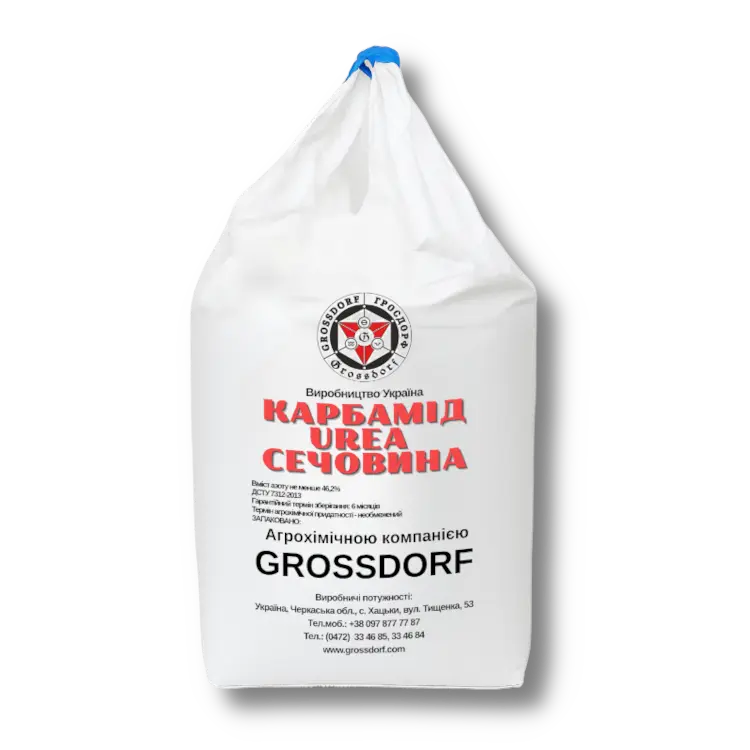
Urea (carbamide)
Urea (carbamide) granulated nitrogen fertilizer
TU U 82.9-36584168-005:2018 packaged mineral fertilizer
Sales Conditions/packaging: EXW, FCA, big bags, 50 kg sacks
Delivery terms: by GROSSDORF’s own transport across Ukraine or self-pickup
| LocationLocation | PricePrice |
|---|---|
| с. Хацьки, Черкаська обл. | 31 500 |
| с. Маяки, Вінницька обл. | 31 500 |
| м. Полтава, Полтавська обл. | 31 500 |
| м. Вознесенськ, Миколаївська обл. | 31 500 |
| м. Прилуки, Чернігівська обл. | 32 000 |
| м. Тернопіль, Тернопільська обл. | 32 000 |
Order: Urea (carbamide)
Urea (CO(NH₂)₂) is a highly concentrated nitrogen fertilizer containing 46% nitrogen in amide form (NH₂). This is the highest nitrogen concentration among solid mineral fertilizers, ensuring cost-effectiveness and a long-lasting, prolonged effect. Amide nitrogen gradually mineralizes in the soil, first converting into ammonium (NH₄⁺) and then into nitrate (NO₃⁻) form. This ensures slow-release, stable plant nutrition without nitrogen shock.
Recommended use:
- suitable for cereals, oilseeds, industrial crops, forage crops, vegetables, root crops, fruit trees, berry bushes, flowers, and lawns
- Base application with soil incorporation;
- pre-sowing application;
- top dressing during vegetation (in granulated or dissolved form);
- foliar feeding (as a 5–10% aqueous solution);
- fertigation after complete dissolution.
Advantages:
- highest nitrogen content among mineral fertilizers;
- slow-release effect reduces nitrogen losses and ensures prolonged feeding;
- versatile usage: soil, foliar, and drip application;
- high solubility — ideal for fertigation;
- compatible with micronutrients, stimulants, and pesticides (after compatibility testing).
Limitations and warnings:
- do not apply on the soil surface without incorporation — risk of nitrogen loss due to NH₃ volatilization;
- do not exceed foliar feeding rates — risk of leaf burn;
- tank mixes must be tested for compatibility before use;
- highly hygroscopic — strict adherence to storage conditions is critical.
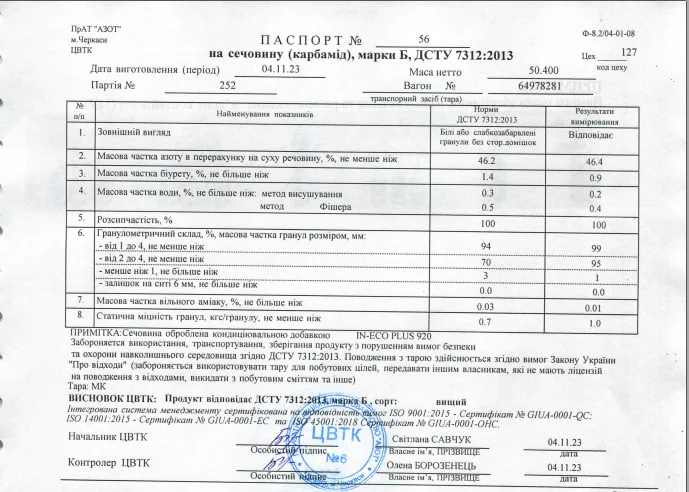
Appearance and color: white or slightly yellowish granules
| Mass fraction of total nitrogen content (as N), % | 46,2 - 46,4 |
| Mass fraction of biuret content, % | 0,8 - 1,4 |
| Moisture content, not more than,% | 0,2 - 0,5 |
| Granulometric composition, % | |
| Less than 1 mm no more | 3 |
| From 2 to 4 mm | 70 - 97 |
| From 1 to 4 mm | 94 - 100 |
- Store in dry, well-ventilated rooms, protected from direct sunlight, at a relative air humidity of no more than 70%, on pallets no lower than 15 cm from the floor, in a single row;
- packaging (bags, big bags) must be hermetically sealed — do not allow moisture penetration;
- Permissible storage temperature: from −20°C to +35°C (do not expose to high humidity; caking and condensation may occur — loosen before use);
- Do not allow contact with acids, alkaline substances, organic compounds, or other fertilizers with which a chemical reaction is possible;
- In case of long-term storage — loosen periodically.
Storage guarantee period: the shelf life of the fertilizer, provided that transportation and storage conditions are observed, is 12 months from the date of manufacture. After the expiration of the guaranteed storage period, the fertilizer must be tested for compliance with technical specifications before use.
| Crop | Application period / rate, kg/100m² | Special application conditions | |||
|---|---|---|---|---|---|
| Pre-sowing cultivation | First feeding | Second feeding | Third feeding | ||
| Grain crops | |||||
| Winter wheat | 07 - 0,9 | - | - | - | in autumn during plowing or digging: if moisture is available, apply with immediate incorporation into the soil after favorable preceding crops. |
| - | 1,3–2,0 | - | - | thinned crops (spring regrowth) | |
| - | 0,9–1,3 | - | - | for crops with optimal stand density (spring regrowth stage) | |
| - | - | 0,9 - 1,3 | - | before stem elongation | |
| - | - | - | 0,6 kg to 3 L of water | to improve grain quality, foliar application | |
| Spring barley | 1,0 - 1,3 | - | - | - | only under sufficient soil moisture with immediate incorporation into the soil |
| - | 0,7 | - | - | no later than the 1–2 leaf stage, provided there is sufficient moisture | |
| Oats | 1,0-1,3 | - | - | - | applied prior to pre-sowing cultivation, only under sufficient soil moisture with immediate incorporation into the soil |
| - | 0,7 | - | - | no later than the 1–2 leaf stage, provided there is sufficient moisture | |
| Corn | 1,3-2,6 | - | - | - | in autumn during plowing or digging: if moisture is available, apply with immediate incorporation into the soil after favorable preceding crops. |
| 1,3-2,0 | - | - | - | applied prior to spring cultivation | |
| - | - | 0,9 | - | at the 3–5 leaf stage, provided there is sufficient moisture | |
| Industrial crops | |||||
| Sunflower | 1,3 | - | - | - | before sowing |
| - | 0,7 | - | - | for fertilization (if needed at the 2–3 leaf pair stage) | |
| Sugar beet | 2,17 | - | - | - | before sowing |
| - | 0,7 | - | - | for fertilization (if needed at the 1–2 leaf pair stage) | |
| Oil crops | |||||
| Winter rapeseed, spring rapeseed | 0,8 | - | - | - | for autumn tillage or before sowing |
| - | 2,6 | - | - | when spring vegetation resumes | |
| - | - | 1,7 | - | at the stem formation stage | |
| foliar fertilization (non-root) simultaneously with pesticide application several times before the flowering stage – 0.2–0.4 kg/are (working solution 3 L/are), with mandatory addition of magnesium sulfate 0.07 kg/are | |||||
| Soybean | 0,7 | - | - | - | before sowing |
| - | 0,7 | - | - | apply as needed before full flowering | |
| Oil flax | 1,0 - 2,0 | - | - | - | before pre-sowing soil cultivation with immediate incorporation into the soil |
| Vegetable crops | |||||
| Tomatoes | 1,7 - 3,0 | - | - | - | during plowing or cultivation, if no other feedings are planned |
| 1,0 - 2,2 | - | - | - | when planning fertilization | |
| - | 0,4 | - | - | 10 to 14 days after seedling transplanting | |
| - | - | 0,4 | - | during flowering | |
| Pepper | 2,6 - 3,0 | - | - | - | during plowing or pre-sowing cultivation (if no other feedings are planned) |
| 0,9 - 1,3 | - | - | - | when planning fertilization | |
| Squash | 2,0 - 2,6 | - | - | - | during plowing or pre-sowing cultivation (if no other feedings are planned) |
| 1,0 - 1,6 | - | - | - | when planning fertilization | |
| Cucumber | 1,8 - 2,6 | - | - | - | during plowing or pre-sowing cultivation (if no other feedings are planned) |
| 0,4 - 1,3 | - | - | - | when planning fertilization | |
| Eggplant | 1,7 - 2,6 | - | - | - | during plowing or pre-sowing cultivation (if no other feedings are planned) |
| 0,9-1,7 | - | - | when planning fertilization | ||
| Potatoes and other root crops | |||||
| Potato | 1,3-2,6 | - | - | - | during plowing |
| 0,4-0,8 | - | - | - | row application during planting | |
| 0,4 | - | - | first fertilization | ||
| Table beet | 1,3-2,0 | - | - | - | during plowing, if moisture is available, apply with immediate incorporation into the soil |
| - | 0,4 | - | - | at the 2–4 leaf stage (if needed) | |
| - | - | 0,4 | - | if the diameter of the root crop is 2.5 cm | |
| Carrot | 2,0 | - | - | - | most effective for basic fertilizer under plowing with immediate incorporation into the soil |
| 0,3-0,4 | - | - | - | during planting | |
| - | 0,4 | - | - | row fertilization | |
| Radish | 2,0 | - | - | - | most effective for basic fertilizer under plowing with immediate incorporation into the soil |
| Onion | 2,0-2,6 | - | - | - | during plowing or pre-sowing cultivation (if no other feedings are planned) |
| 1,1-1,7 | - | - | - | when planning fertilization | |
| - | 0,4 | - | - | 10–14 days after emergence | |
| - | - | 0,4 | at the bulb formation stage | ||
| Garlic | 1,3-2,6 | - | - | - | during plowing or pre-sowing cultivation (if no other feedings are planned) |
| 1,1-1,3 | - | - | - | when planning fertilization | |
| - | 0,5-0,7 | - | - | in early spring | |
| - | - | 0,4 | for plant heights of 15-18 cm | ||
| - | - | - | 0,2 | when forming bulbs, fertilize in combination with phosphorus and potassium fertilizers (P20:K20) | |
| Fruit trees and berry bushes | |||||
| Apple tree | - | 1,7-2,0 | - | - | Early spring fertilization with immediate incorporation into the soil, provided there is sufficient moisture |
| - | 0,02 | - | - | watering at the root: 10 liters of water per 1 m² | |
| Pear | - | 1,4-1,5 | - | - | Early spring fertilization with immediate incorporation into the soil, provided there is sufficient moisture |
| - | 0,015 | - | - | watering at the root: 10 liters of water per 1 m² | |
| Sour cherry | - | 2,5 | - | - | Early spring fertilization with immediate incorporation into the soil, provided there is sufficient moisture |
| - | 0,025-0,03 | - | - | watering at the root: 10 liters of water per 1 m² | |
| Raspberry | - | 1,3 | - | - | Early spring fertilization with immediate incorporation into the soil, provided there is sufficient moisture |
| - | 0,015-0,02 | - | - | watering at the root: 10 liters of water per 1 m² | |
| Wild strawberry/Strawberry | - | 1,1-1,3 | - | - | early spring fertilization before the start of vegetation with immediate incorporation into the soil, provided there is sufficient moisture |
| - | 0,015 - 0,020 | - | - | watering at the root: 10 liters of water per 1 m² | |
| Grape | - | 2,3-2,5 | - | - | early spring fertilization before the start of vegetation with immediate incorporation into the soil, provided there is sufficient moisture |
| - | 0,023 - 0,025 | - | - | watering at the root: 10 liters of water per 1 m² | |
| Blueberry | Fertilize twice a year (April and August–September); after planting apply 1 tbsp (2nd year), 2 tbsp (3rd), 4 tbsp (4th), 8 tbsp (5th), and 16 tbsp or 40–50 g per mature bush (6th year and beyond). | ||||
| Flowers and lawn grasses | |||||
| Rose | - | 0,03 per 10 liters of water | - | spraying before and after flowering nourishes the plant and protects it from fungal diseases. | |
| Tulip | - | 1,3 | - | - | when plants are 5–8 cm tall |
| - | - | 0,5 | - | 10–15 days after the first fertilization, in combination with phosphorus and potassium fertilizers. | |
| Lawn grasses | 1,3 | - | - | - | in autumn before lawn establishment (on heavy soils), provided there is moisture, with immediate incorporation into the soil. |
| - | 1,2 | - | - | as needed, when the soil warms up to 10 C | |
| - | - | 1,2 | - | as needed, from the beginning of May to the end of June | |
These fertilizer application rates were developed by the Department of Agrochemistry and Soil Science of Uman National University of Horticulture under the scientific supervision of Doctor of Agricultural Sciences, Professor H.M. Hospodarenko, commissioned by AC GROSSDORF, and are the intellectual property of AC GROSSDORF; they may be distributed only with reference to the owner. The application rates provided are general and do not eliminate the need for agronomist consultation.