
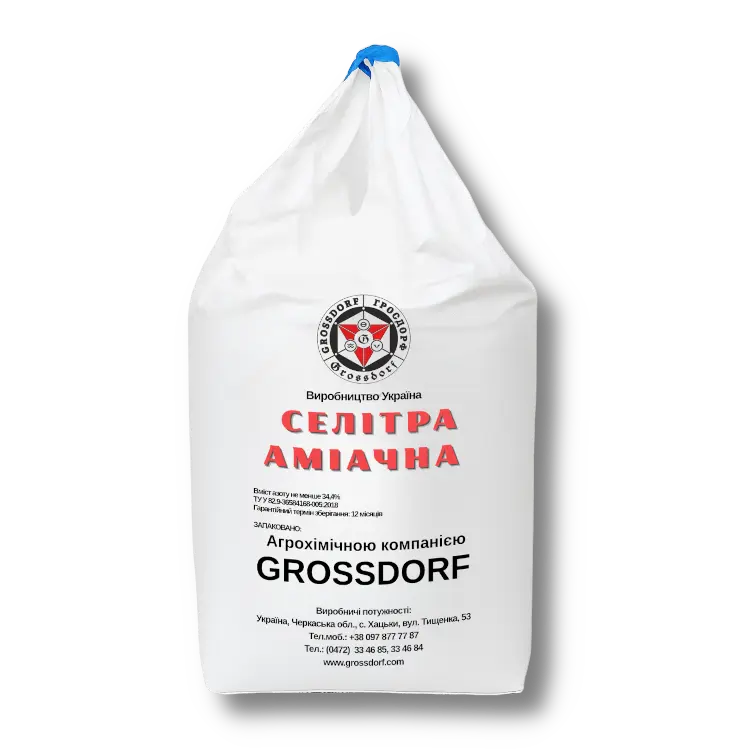
Ammonium nitrate
Ammonium-nitrate fertilizer (nitrogen in NH₄:NO₃ ratio – 1:1)
TU U 82.9-36584168-005:2018 packaged mineral fertilizer
Sales conditions/packaging: EXW, FCA, big bag, 50 kg sacks
Delivery terms: by GROSSDORF’s own transport across Ukraine or self-pickup
| LocationLocation | PricePrice |
|---|---|
| с. Хацьки, Черкаська обл. | 27 500 |
| с. Маяки, Вінницька обл. | 27 500 |
| м. Полтава, Полтавська обл. | 27 500 |
| м. Вознесенськ, Миколаївська обл. | 27 500 |
| м. Прилуки, Чернігівська обл. | 27 500* |
| м. Тернопіль, Тернопільська обл. | 27 500 |
Order: Ammonium nitrate
Ammonium nitrate (NH₄NO₃) – ammonium nitrate is one of the most widely used nitrogen fertilizers, containing 34.4% total nitrogen in two forms:
- nitrate (NO₃⁻) — rapidly absorbed by plants immediately after application;
- ammonium (NH₄⁺) — retained in the soil, providing a prolonged release effect.
This combination provides a quick effect for an active start and prolonged action for stable nutrition over several weeks. Thanks to its high solubility, ammonium nitrate is effective even under moderate moisture conditions and is suitable for all soil types. It is used as a base, pre-sowing, or top-dressing fertilizer, as well as in fertigation systems after dissolution.
Recommended use:
- for all agricultural crops: cereals, industrial crops, vegetables, and forage crops;
- for base application, pre-sowing, top dressing, and fertigation;
- especially effective on crops that require a high initial dose of nitrogen with prolonged action.
Advantages:
- fast-acting and long-lasting nitrogen availability;
- suitable for spring start-up, intensive in-season feeding, and fertigation;
- highly soluble — can be used in liquid form;
- high nitrogen concentration — lower application rates, higher efficiency;
- versatile — compatible with all modern plant nutrition systems.
Limitations and warnings:
- do not apply to dry soil without moisture — risk of partial nitrification “burn”;
- do not mix with crop protection products (CPPs) without compatibility testing;
- avoid storing near heat sources, open flames, or flammable materials;
- potentially explosive under overheating or contamination — follow all storage regulations carefully.
Appearance and color: crystalline powder or granules of white color with a yellowish tint without mechanical mixtures
| Масова частка азоту, % | 34,4 |
| Mass fraction of water, % | 0,2 - 0,3 |
| Granulometric composition, % | |
| Mass fraction of granules from 1 to 4 mm | 95 |
| Mass fraction of granules from 2 to 4 mm, not less than | 80 |
| Mass fraction of granules less than 1 mm | 3 |
- Store in dry, well-ventilated rooms, protected from direct sunlight, at a relative air humidity of no more than 70%, on pallets no lower than 15 cm from the floor, in a single row;
- Packaging (bags, big bags) must be hermetically sealed — do not allow moisture penetration;
- Permissible storage temperature: from −20°C to +35°C (do not expose to high humidity; caking and condensation may occur — loosen before use);
- Do not allow contact with acids, alkaline substances, organic compounds, or other fertilizers with which a chemical reaction is possible;
- In case of long-term storage — loosen periodically;
- Do not store near flammable materials, acids, alkalis, oils, or organic fertilizers (the distance to heat sources or open flame must be at least 5 meters);
Storage shelf life: the fertilizer’s shelf life, subject to transportation and storage rules, is 12 months from the date of manufacture. After the shelf life expires, the fertilizer must be checked for compliance with technical specifications before use. Ammonium nitrate is an explosion-hazardous product under certain conditions, so storage rules must be strictly followed and contact with ignition sources must be avoided.
| Crop | Application period / rate, kg/100m² | Special application conditions | |||
|---|---|---|---|---|---|
| Pre-sowing cultivation | First feeding | Second feeding | Third feeding | ||
| Grain crops | |||||
| Winter wheat | 0,9–1,2 | - | - | - | before sowing, after satisfactory precursor crops |
| - | 1,7–2,6 | - | - | for thinned crops (spring regrowth) | |
| - | 1,2–1,7 | - | - | for stands with optimal density (spring regrowth) | |
| - | - | 0,9–1,2 | - | until stem elongation phase | |
| Spring barley | 0,9–1,7 | - | - | - | before sowing |
| - | 0,9 | - | - | not later than the appearance of 1–2 leaves, if moisture is present | |
| Corn | 1,7–3,5 | - | - | - | for autumn plowing on heavy soils in insufficient moisture zones |
| 1,7–2,6 | - | - | - | for spring cultivation on heavy soils in sufficient moisture zones | |
| - | 0,9 | - | - | feeding at the 3–5 leaf stage if moisture is available | |
| Oats | 0,9–2,6 | - | - | - | during pre-sowing cultivation |
| - | 0,9 | - | - | not later than the appearance of 1–2 leaves, if moisture is present | |
| Industrial crops | |||||
| Sunflower | 2,0 | - | - | - | before sowing |
| - | 0,9 | - | - | if needed, at the 2–3 pairs of leaves stage | |
| Soybean | 1,0 | - | - | - | before sowing |
| - | 0,9 | - | - | if needed, before the onset of flowering | |
| Sugar beet | 3,0 | - | - | - | before sowing |
| - | 0,9 | - | - | if needed, at the 1–2 pairs of leaves stage | |
| Oil crops | |||||
| Winter rapeseed | 0,9 | - | - | - | for autumn tillage or before sowing |
| - | 3,0 | - | - | resumption of spring vegetation | |
| - | - | 2,3 | - | beginning of budding | |
| - | - | - | 1,2 | at full budding stage under sufficient moisture conditions | |
| Oil flax | 1,3–2,6 | - | - | - | before sowing |
| - | 0,5–0,7 | - | - | at the “christmas tree” stage (plants 5–10 cm tall with 5–6 pairs of leaves) if nitrogen was not applied before sowing | |
| Vegetable crops | |||||
| Tomatoes | 2,0–4,0 | - | - | - | during plowing, if no feedings are planned |
| 1,2–3,0 | - | - | - | when feeding is planned | |
| - | 0,6 | - | - | 10–12 days after seedling transplanting | |
| 1,2–2,3 | - | - | - | when feeding is planned | |
| Pepper | 3,5–4,0 | - | - | - | during plowing or pre-sowing cultivation, if no feedings are planned |
| 1,2–1,7 | - | - | - | when feeding is planned | |
| - | 0,6 | - | - | 10–12 days after seedling transplanting | |
| - | - | 0,6 | - | during flowering and fruiting | |
| Squash | 2,6–3,5 | - | - | - | during plowing or pre-sowing cultivation (if no feedings are planned) |
| 1,3–2,2 | - | - | - | when feeding is planned | |
| - | 0,6 | - | - | during flowering | |
| - | - | 0,6 | - | at the beginning of fruiting | |
| Cucumber | 2,5–3,5 | - | - | - | during plowing or pre-sowing cultivation (if no feedings are planned) |
| 0,6–1,7 | - | - | - | when feeding is planned | |
| - | 0,6 | - | - | for the formation of 3-4 leaves | |
| - | - | 0,9 | - | complete before the cucumber vine spreading begins | |
| Eggplant | 2,3–3,5 | - | - | - | during plowing or pre-sowing cultivation (if no other feedings are planned) |
| 1,2–2,3 | - | - | - | when feeding is planned | |
| - | 0,6 | - | - | 10–12 days after seedling transplanting | |
| - | - | 0,6 | - | 10–12 days after the first feeding | |
| Potatoes and other root crops | |||||
| Potato | 1,8–3,5 | - | - | - | in zones of unstable or insufficient moisture, apply in autumn during plowing or in spring during cultivation |
| - | 0,6–1,0 | - | - | row feeding during inter-row cultivation when plants are 15–20 cm tall, if moisture is present | |
| Table beet | 2,0–2,6 | - | - | - | in zones of unstable or insufficient moisture, apply in autumn during plowing or in spring during pre-sowing cultivation |
| 0,4–0,6 | - | - | row feeding | ||
| Carrot | 2,0–3,0 | - | - | - | in zones of unstable or insufficient moisture, apply in autumn during plowing or in spring during pre-sowing cultivation |
| - | 0,6 | - | - | row feeding | |
| Radish | 1,75–2,9 | - | - | - | in zones of unstable or insufficient moisture, apply in autumn during plowing |
| Onion | 2,6-3,5 | - | - | - | during plowing or pre-sowing cultivation (if no other feedings are planned) |
| 1,5–2,3 | - | - | - | when feeding is planned | |
| - | 0,6 | - | - | 10–14 days after emergence | |
| - | - | 0,6 | - | at the bulb formation stage | |
| Garlic | 2,6-3,5 | - | - | - | during plowing or pre-sowing cultivation (if no other feedings are planned) |
| 0,6–1,6 | - | - | - | when feeding is planned | |
| - | 0,7–0,9 | - | - | in early spring | |
| - | - | 0,58 | - | when plants are 15–18 cm tall | |
| - | - | - | 0,3 | when forming bulbs, apply combined with phosphorus and potassium fertilizers (P20:K20) | |
| Fruit trees and berry bushes | |||||
| Apple tree | 2,0–2,8 | - | - | - | spring feeding before the start of vegetation, during bud break–flowering |
| Pear | 1,8–2,0 | - | - | - | spring feeding before the start of vegetation, during bud break–flowering |
| Sour cherry | 3,4 | - | - | - | feeding before flowering |
| Raspberry | 1,8 | - | - | - | feeding before the start of vegetation |
| Wild strawberry/Strawberry | 1,8 | - | - | - | feeding before the start of vegetation |
| Grape | 3,5 | - | - | - | feeding before the start of vegetation |
| Blueberry | Apply feeding twice a year: at the start of vegetation (April) and at the end (August–September). After planting: year 2 – 1 tablespoon, year 3 – 2 tbsp, year 4 – 4 tbsp, year 5 – 8 tbsp, year 6 and subsequent years – 16 tbsp or 40–50 g per mature bush. | ||||
| Flowers and lawn grasses | |||||
| Rose | 0,014-0,016 | - | - | - | into the planting hole |
| - | 0,015–0,020 per 10 liters of water | - | - | after pruning and until the first leaf emerges. Fluid consumption – 10 l/1 m2 | |
| - | - | 0,02–0,03 per 10 liters of water | - | during the period of intensive growth/before the start of mass flowering. Fluid consumption – 10 l/1 m2 | |
| Tulip | - | 2,0 | - | - | when the plants are 5–8 cm tall |
| Lawn grasses | 1,8 | - | - | - | in autumn before lawn establishment (on heavy soils) |
| - | 1,5 | - | - | as needed, when the soil warms up to 10 C | |
| - | - | 1,5 | - | as needed, from the beginning of May to the end of June | |
These fertilizer application rates were developed by the Department of Agrochemistry and Soil Science of Uman National University of Horticulture under the scientific supervision of Doctor of Agricultural Sciences, Professor H.M. Hospodarenko, commissioned by AC GROSSDORF, and are the intellectual property of AC GROSSDORF; they may be distributed only with reference to the owner. The application rates provided are general and do not eliminate the need for agronomist consultation.